




Buying baby shoes should be simple, but labels like "4C," "12–18 months" and "US 5" can leave anyone second-guessing. And because little feet grow so quickly, the pair that fit last month might already be snug.
This baby shoes size chart lines up sizes by age with real foot lengths, then walks you through measuring your child's feet at home, how much growing room to leave and how often to check the fit. It draws on guidance from foot specialists at the American Orthopaedic Foot & Ankle Society, the American Podiatric Medical Association and Cleveland Clinic, so you can order with confidence, whether the shoes are for your own little one or a gift.
The short answer: On the Baby Waves chart below, babies from about 6 to 18 months wear US sizes 3 to 5, and toddlers from 18 months to 3 years wear US sizes 6 to 7. Age is only a starting point, though. Sizes vary by brand, so measure from the back of the heel to the tip of the longest toe and match that length to the chart. Once the shoes are on, foot specialists suggest about ½ inch of space in front of the longest toe.
Baby shoes size chart by age
Use this chart to find a starting size, then confirm it with a quick at-home measurement. Foot lengths are measured from the back of the heel to the tip of the longest toe.
| Age (approx.) | US size | UK / AU size | Foot length (inches) | Foot length (cm) |
|---|---|---|---|---|
| 6–9 months | 3 | 2 | 4–4.4" | 10.2–11.2 cm |
| 9–12 months | 4 | 3 | 4.4–4.7" | 11.2–11.9 cm |
| 12–18 months | 5 | 4 | 4.7–5.1" | 11.9–13.0 cm |
| 18–24 months | 6 | 5 | 5.1–5.5" | 13.0–14.0 cm |
| 2–3 years | 7 | 6 | 5.5–5.9" | 14.0–15.0 cm |
A few things to keep in mind when reading any baby shoe size chart:
- Ages are averages. Two babies the same age can be a full size apart, so the foot-length columns matter more than the age column.
- Sizes vary by brand. Foot and ankle surgeons at FootCareMD point out in their 10 points of proper shoe fit that the size marked inside a shoe can differ from brand to brand, so a size is just a starting point. Always check the chart for the specific shoe you're buying.
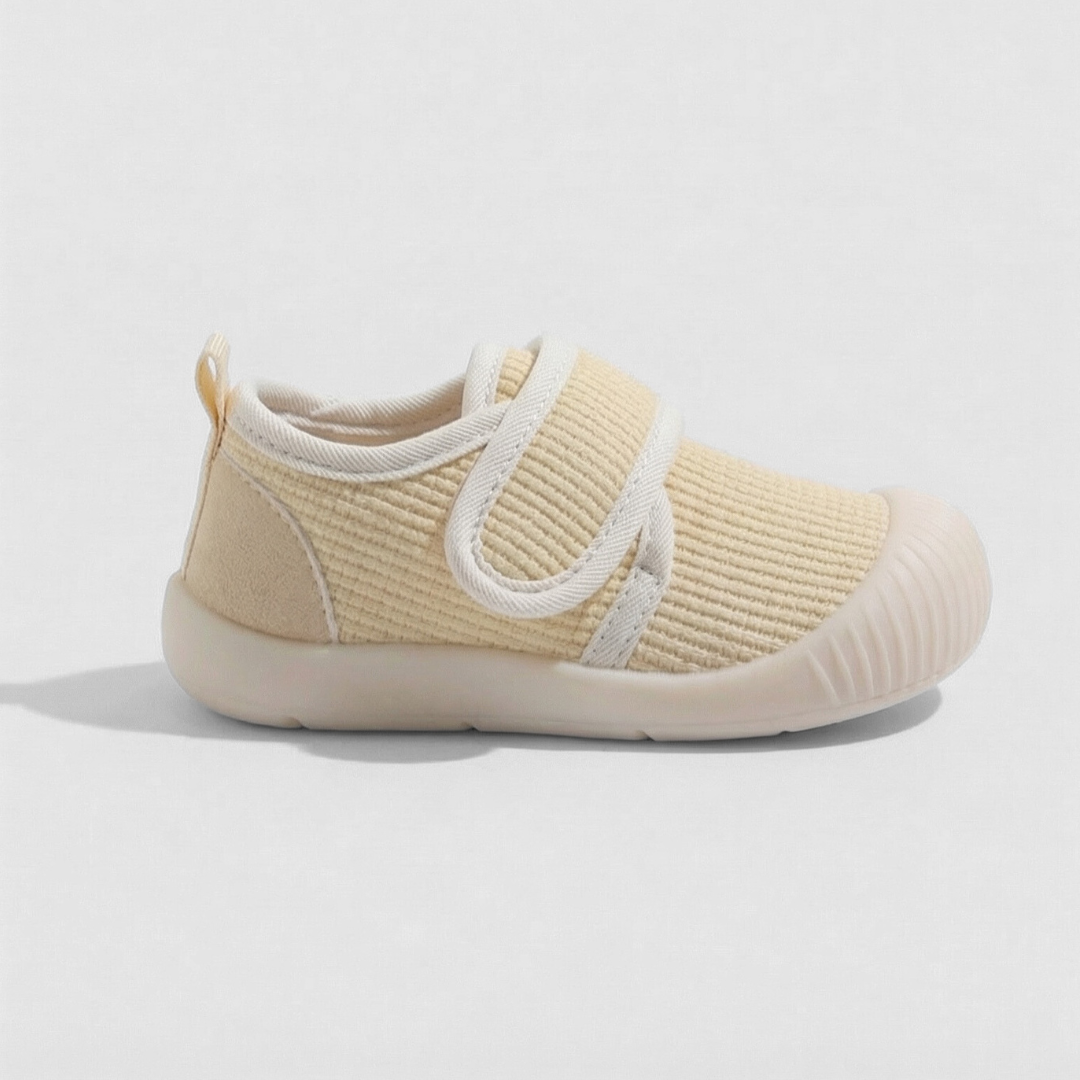
- Our chart is for Baby Waves shoes. It covers our ComfortPlus+, ComfortKnit and ComfortFlex styles. You'll find the same chart, plus a step-by-step measuring guide, on our baby shoe size guide.
What about babies under 6 months?
Young babies don't need shoes. Nemours KidsHealth suggests holding off on a first pair until your baby is walking, since shoes are mainly for protecting feet outdoors and won't help a baby walk sooner. Barefoot is best for foot development, and socks or booties with nonskid soles are fine for chilly toes. According to the CDC, most toddlers take a few steps on their own by 15 months and walk without holding on by 18 months, so that's when most families buy a first real pair. (Our guide to when babies start walking covers the full timeline.)
What does "C" mean in baby shoe sizes?
On US kids' shoes, the "C" after a number stands for "child," which marks it as a baby or toddler size. A 4C is a toddler size 4, and a 6C is a toddler size 6. It's the same as the "US size" column above; some brands simply add the letter.
That's also why "What size are 9 to 12 month baby shoes?" doesn't have one answer. On our chart, 9–12 months is a US 4 (for feet about 4.4 to 4.7 inches long), but another brand might label its 12-month shoe a 3C or a 4C. When in doubt, go by foot length, not the age on the label.
How to measure your baby's feet at home
Cleveland Clinic notes that a shoe store measurement is the most accurate option, because staff have the right equipment for length and width. If you're shopping online (or it's just not nap-friendly to get to a store), you can get a reliable number at home in a few minutes:
- Measure later in the day. FootCareMD recommends measuring at the end of the day, when feet are at their largest.
- Have your child stand on a sheet of paper on a hard floor, heel against a wall. Standing with some weight on each foot elongates it slightly, which Cleveland Clinic says gives a more accurate measurement.
- Mark the heel and the longest toe (or trace around the foot). Make sure the toes are flat and straight, not curled. A second adult or a favorite toy to hold helps a lot with wiggly toddlers.
- Measure both feet. Most people have one foot that's a little bigger. The American Podiatric Medical Association advises buying for the larger foot.
- Match the longer measurement to the chart. If your child falls between sizes or sits at the very top of a range, choose the larger size.
If your little one isn't standing on their own yet, they likely don't need walking shoes. Soft socks or booties are plenty for now.

How much room should baby shoes have?
A little growing room is good. A lot isn't. Here's what foot specialists recommend:
- About ½ inch at the toes. In its guide to choosing shoes for your child, FootCareMD suggests taking out the insole (if it's removable) and having your child stand on it. With the heel at the back, there should be about ½ inch between the toes and the front of the insole. The APMA's guideline is similar: about 10 to 15 millimeters of toe room in front of the longest toe.
- The fingertip test. If the insole doesn't come out, have your child stand in the shoes and press on the front. You should be able to fit the tip of your finger between their toes and the end of the shoe.
- Not too big. Cleveland Clinic says one of the most common issues is parents buying shoes too big so they'll last longer. Shoes a half or whole size too large can make new walkers more likely to trip and fall. It suggests 1 to 2 centimeters of space, and says more than 3 centimeters is too big.
- Enough width and depth. The APMA recommends a toe box at least as wide as the widest part of the foot, and FootCareMD suggests rounded toe boxes and checking that the top of the shoe doesn't press on the toes or toenails.
New shoes should feel comfortable right away. If a pair needs "breaking in," FootCareMD says it either wasn't well designed or doesn't fit your child's foot.

How fast do baby feet grow?
Faster than you might think, and in spurts. According to FootCareMD:
- Toddlers under 16 months often grow more than half a size in 2 months.
- From 16 to 24 months, feet grow about half a size every 3 months.
- From ages 2 to 3, it's about half a size every 4 months.
That's why FootCareMD says children may need new shoes every 3 to 4 months, and why the APMA recommends rechecking size every 4 to 6 months. For new walkers, who grow fastest, a quick fingertip check every few weeks only takes a moment.
Signs your baby's shoes are too small
- Red marks or blisters after wearing them, which FootCareMD says can mean your child needs a larger or wider shoe
- Toes pressing right up against the front during the fingertip test
- The top of the shoe pressing on the toes or toenails
- Ingrown toenails, since MedlinePlus lists poorly fitting shoes as one of the most common causes
Buying baby shoes as a gift? A few tips
Shoes make a sweet gift, but sizing someone else's baby is tricky. For a newborn, practical basics from our baby must-haves list for first-time parents often make a more useful gift. These tips help:
- Ask for a foot length, not just an age. A quick heel-to-toe measurement is far more reliable than "she's 11 months."
- When unsure, choose the larger size. If the baby is between sizes, or you only know their age, the bigger size gives them a little time to grow. Just avoid jumping up more than one size.
- Pick the right kind of shoe. KidsHealth recommends lightweight, flexible shoes with nonskid soles that fit well, and Vanderbilt Children's Hospital advises choosing a flexible, soft shoe over a stiff one. Our guide to first walking shoes for baby covers what to look for, and our post on baby mesh shoes explains why breathable uppers matter.
- Check the exchange policy. Unworn Baby Waves shoes can be exchanged within 14 days (see our return policy), so the parents can swap for a better size.
Our flexible first walker shoes come in five sizes from 6 months to 3 years, and if you're unsure which one to choose, you can always send us a foot measurement and we'll help.

When to talk with your pediatrician
Shoe size is about comfort and safety, but it can't fix a foot problem. Some things that worry parents are actually normal: Children's Hospital of Philadelphia explains that flat feet are normal in babies and toddlers because their arches haven't developed yet, and FootCareMD notes that most children don't need special arch support. CHOP does recommend talking with your child's doctor if your child has foot pain. It's also a good idea to check in if you notice a limp, blisters or redness that keep coming back, or anything about the way your child walks that concerns you.
Frequently asked questions
What size shoe does a 1-year-old wear?
On the Baby Waves chart, most 1-year-olds wear a US 4 or 5, depending on whether their feet are closer to 4.5 or 5 inches long. Because sizes vary between brands, measuring is the best way to know for sure.
What size shoe does a 2-year-old wear?
On our chart, toddlers around 18 to 24 months usually wear a US 6, and 2- to 3-year-olds usually wear a US 7. Again, foot length matters more than age, so measure before you buy.
Should I buy baby shoes a size bigger?
Leave some growing room, but don't overdo it. Foot specialists suggest about ½ inch (roughly 1 to 1.5 centimeters) in front of the longest toe. Cleveland Clinic cautions that shoes a half or whole size too big can make new walkers more likely to trip and fall.
Are baby shoe sizes the same across brands?
No. The size printed inside a shoe can differ from brand to brand, so always compare your child's foot length with the size chart for the specific shoe you're buying.
This article is for general informational purposes only and isn't a substitute for professional medical advice. Every child's feet grow and develop at their own pace. If you have questions or concerns about your child's feet, walking or health, please talk with your pediatrician.
Sources
- American Orthopaedic Foot & Ankle Society, FootCareMD, How Do I Choose Shoes for My Child? and 10 Points of Proper Shoe Fit
- American Podiatric Medical Association, Buying Children's Footwear
- Cleveland Clinic, How to Find the Best Shoe (and Fit) for Your Child
- Nemours KidsHealth, Is My Baby Ready for Shoes?
- Vanderbilt Children's Hospital, How to Choose Shoes for Your Child
- Children's Hospital of Philadelphia, Flat Feet
- MedlinePlus (U.S. National Library of Medicine), Ingrown Toenail
- Centers for Disease Control and Prevention (CDC), Milestones by 15 Months and Milestones by 18 Months





Share and get 15% off!
Simply share this product on one of the following social networks and you will unlock 15% off!