




Tiny baby shoes are hard to resist. But if you're wondering whether your little one actually needs them, and when to buy first walking shoes for baby, you're asking a great question. The answer is simpler (and easier on your wallet) than you might think.
Here's what pediatric experts say about when babies need shoes, what to look for in a first pair, how to check the fit at home, and the features you can safely skip.
The short answer: Babies don't need shoes until they're walking, and especially walking outside. Barefoot is best indoors. When it's time, the American Academy of Pediatrics (AAP) recommends first shoes that are closed-toe, comfortable and flexible, with nonskid soles and room to grow. Special arches, inserts and stiff, high backs aren't needed.
Do babies need shoes?
Not at first. In the early months, the AAP explains that babies' feet develop best when they're not confined in shoes, and socks are all that's needed to keep their feet warm. Once children start walking outdoors, though, they need shoes for protection.
That's really the main job of a first shoe: protection. As Nemours KidsHealth puts it, shoes are mainly for protecting a baby's feet, especially outdoors, and putting them on sooner won't help your baby learn to walk any faster or better. Shoes with hard, stiff soles can even make it harder, because they restrict natural foot movement.
Is it better for babies to walk barefoot?
At home, on clean and safe floors, yes. KidsHealth says barefoot is still best for a baby's foot development, and socks or booties with nonskid soles are fine for chilly toes. Pathways.org, whose materials are developed with pediatric physical and occupational therapists, agrees: before your baby gets the hang of walking, barefoot is better. If your baby is pulling up or taking first steps in socks, make sure they have nonskid soles so they don't slip.

When to buy first walking shoes for baby
The best time to buy your baby's first walking shoes is when they're walking and ready to do some of it outside, on sidewalks, at the park or anywhere their feet need protection. An 8-month-old who loves to stand with a little help doesn't need them yet.
For most families, that moment comes somewhere between the first birthday and 18 months. According to the CDC, most toddlers take a few steps on their own by 15 months and walk without holding on by 18 months. Every baby is different, so watch your child rather than the calendar. (For the full timeline, see our guide on when babies start walking.)
Signs it's time for a first pair:
- Your baby is taking steps on their own, not just cruising along furniture.
- You're heading outside, where there's rough pavement, hot or cold ground, or things they could step on.
- They need some grip on surfaces that are slippery or not safe for bare feet.

What to look for in first walking shoes
You don't need anything fancy. The AAP's guidance on baby's first shoes comes down to a few simple features:
- Flexible soles. Your baby's foot should be able to bend and move naturally. KidsHealth recommends lightweight, flexible shoes and warns against hard, stiff ones. A quick at-store check: the shoe should bend easily in your hands.
- Nonskid soles. Grippy soles help keep new walkers steady on slippery floors, as the AAP notes.
- Closed toes. The AAP recommends closed-toe shoes to protect little toes outdoors.
- Comfort and a good fit. Not too loose and not too tight, with room for toes to wiggle.
- Room to grow. Little feet grow fast (more on that below), so there should be a bit of space at the front.
- Lightweight. KidsHealth recommends lightweight shoes for new walkers.
The AAP notes that sneakers are a great choice. Any style that checks these boxes, from soft-soled first walkers to simple sneakers, can work. Weighing materials? Our guide to baby mesh shoes explains when breathable mesh makes sense.
What you can skip
Here's where a lot of parents get upsold. According to the AAP, your child does not need wedges, inserts, high backs, reinforced heels, special arches or other features designed to shape and support the feet. These have no proven benefit for the average child and may actually make it harder to walk.
What about flat feet and arch support?
If your baby's feet look completely flat, that's expected. The AAP explains that babies are often born with flat feet, and young babies have a fat pad on the inner border of the foot that hides the arch. Flat feet normally disappear by age 6 as the arches develop.
The American Academy of Orthopaedic Surgeons' OrthoInfo adds that most children are born with very little arch, and the arches gradually take shape as children grow and walk. And according to MedlinePlus from the National Library of Medicine, a child's feet will grow and develop the same whether or not special shoes, inserts, heel cups or wedges are used. The AAP also says shoe inserts won't help a child develop an arch. In other words, a first walking shoe doesn't need to "build" an arch. It just needs to protect the foot and let it move.
How to check the fit at home
A good fit matters more than any feature on the box. A few simple checks:
- Measure at home first. Our size guide walks you through measuring your baby's feet at home. Our baby shoes size chart by age shows which size fits at each stage.
- Leave about a finger's width at the toes. The AAP says the top of your child's big toe should be about a finger-width from the inside edge of the shoe.
- Feel for wiggle room. Pathways.org suggests running your fingers across the top of the shoe. You should be able to feel your baby's toes slightly. If they're pressing firmly against the top, the shoe might be too tight.
- Make sure closures close. Straps or laces should fasten all the way without strain, according to Pathways.org.
- Watch them move. Your child should be able to walk, run, jump and move as usual in their shoes.

One more tip from the AAP worth remembering: it's better to have no shoes at all than shoes that are too tight.
How often do toddlers need new shoes?
More often than you'd expect. The AAP says a first pair of shoes will probably last only 2 to 3 months, and recommends checking the fit about once a month during this stage. Pathways.org notes that some children may need new shoes as often as every 6 to 8 weeks, since feet grow very quickly in the first 5 years.
Signs it's time to size up, according to Pathways.org, include toes pressing firmly against the top of the shoe, closures that no longer fasten comfortably, shoes that seem tight, or a child who seems uncomfortable in them.
Keep practicing barefoot at home
Even after the first pair arrives, shoes are mostly for outdoors. At home, plenty of barefoot time (or nonskid socks on cold floors) lets your baby keep feeling the ground as they practice. For playful ways to build strength and balance, try our 10 gentle, play-based ways to help your baby walk.
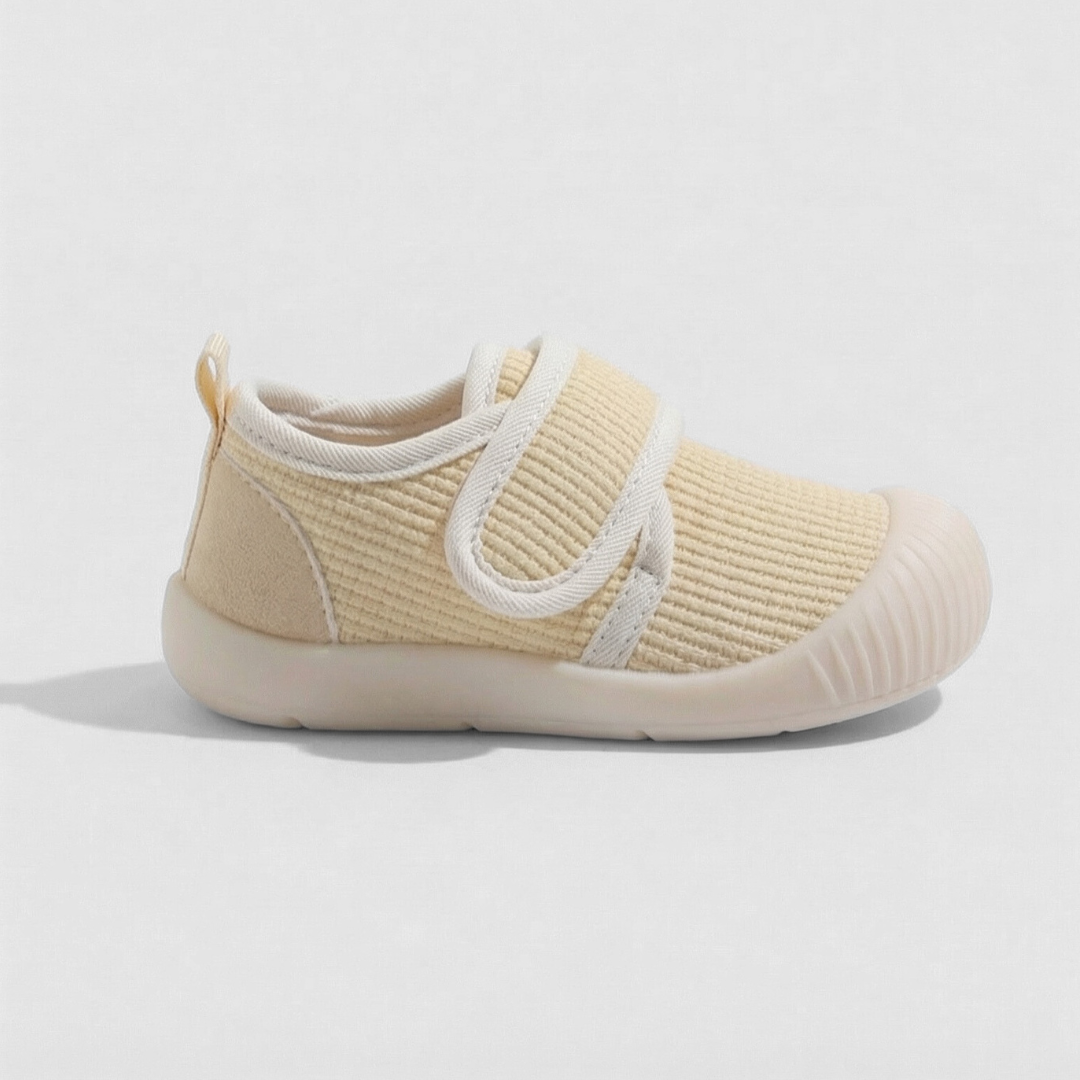
When you're ready for outdoor shoes, our flexible first walkers are designed around the features above: soft, bendable soles, nonskid grip and room for growing toes.
When to talk with your pediatrician
Most wobbles, flat-looking feet and toe-heavy steps are a normal part of learning to walk. The AAP suggests checking in with your pediatrician if your child seems to be in pain, if walking on the toes or the balls of the feet continues after age 2, or if you have other concerns about how they walk. MedlinePlus also notes that children should be evaluated if they have foot, ankle or lower leg pain. You can keep track of milestones between visits with the free CDC Milestone Tracker app.
Frequently asked questions
Should you put shoes on a baby before they can walk?
There's no need. Shoes are mainly for protection once babies walk outside, and KidsHealth notes that putting them on early won't help your baby walk sooner. Here's what really does help: our list of things to help babies walk. Socks or soft booties are enough to keep pre-walkers' feet warm.
What are the best shoes for a baby who just started walking?
Look for lightweight, flexible shoes with nonskid soles, closed toes and a little room to grow. The AAP says sneakers are a great choice, and that features like special arches or reinforced heels aren't needed for the average child.
Do babies need high-top shoes for ankle support?
Not for support. The AAP lists high backs and reinforced heels among the features children don't need. Some parents still like a higher shoe simply because it's harder for little ones to kick off, and that's a matter of preference.
Can my baby wear socks instead of shoes indoors?
Yes. Indoors on safe floors, bare feet are best, and socks or booties with nonskid soles are a good option when it's chilly, according to KidsHealth and Pathways.org. Our guide to non-slip socks for infants covers when grip socks help and what to look for.
This article is for general informational purposes only and isn't a substitute for professional medical advice. Every child's feet develop at their own pace. If you have questions or concerns about your child's health or development, please talk with your pediatrician.
Sources
- American Academy of Pediatrics, HealthyChildren.org, Movement Milestones in Babies 8 to 12 Months Old (includes "Your baby's first shoes")
- American Academy of Pediatrics, HealthyChildren.org, Shoes for Active Toddlers
- American Academy of Pediatrics, HealthyChildren.org, Flat Feet and Fallen Arches: When Is Treatment Needed?
- Nemours KidsHealth, Is My Baby Ready for Shoes?
- Pathways.org, When Do Babies Start Wearing Shoes?
- American Academy of Orthopaedic Surgeons, OrthoInfo, Flexible Flatfoot in Children
- MedlinePlus, U.S. National Library of Medicine, Flat Feet
- Centers for Disease Control and Prevention (CDC), Milestones by 15 Months, Milestones by 18 Months and the Milestone Tracker App





Share and get 15% off!
Simply share this product on one of the following social networks and you will unlock 15% off!