




Few moments feel as big as your baby's first wobbly steps. If you're wondering when they'll happen, or whether your little one is "on track," you're not alone. It's one of the most-searched questions new parents ask.
Here's what experts say about when babies start walking, the stages that lead up to it, and simple, playful ways to support your baby along the way.
The short answer: Many babies take their first steps around their first birthday, but starting earlier or later is completely normal. By about 18 months, most children are walking on their own.
The walking timeline: what to expect and when
Walking doesn't happen overnight. It's the result of months of building strength, balance and confidence. Every baby moves at their own pace, but here's the general order of things, based on the CDC's developmental milestones. For the full first year, see our guide to baby milestones by month.
Around 9 months: sitting and getting ready
Most babies can sit without support and get themselves into a sitting position. Many are crawling, scooting or rolling to get around, all of which build the core and leg strength they'll need later.
Around 12 months: pulling up and cruising
By their first birthday, most babies pull up to stand and walk while holding on to furniture. This sideways shuffle along the couch is called "cruising," and it's a great sign that walking is on the way.

Around 15 months: first independent steps
By 15 months, most toddlers take a few steps on their own. The first ones are often shaky, with feet set wide apart for balance and arms up like a tightrope walker.
Around 18 months: walking on their own
By 18 months, most children walk without holding on to anyone or anything. Many also climb on and off the couch or a chair without help. Walking is just one of the 18-month milestones; our guide to toddler milestones by age covers the rest.
Around 2 years: running and kicking
By age 2, most toddlers run, kick a ball and walk up a few stairs, with or without a helping hand.
Signs your baby is getting ready to walk
- Pulling up to stand using furniture, the crib rails or your legs.
- Cruising along furniture while holding on.
- Standing briefly without support, even for just a second or two.
- Squatting and standing back up to grab a toy.
- Bouncing or "dancing" while standing and holding on.
- Letting go for a moment before grabbing support again.
Once babies feel secure standing, the American Academy of Pediatrics (AAP) notes, they'll start taking tentative steps while holding on. Most children go from those first steps to confident walking surprisingly quickly.
8 simple ways to help your baby learn to walk
You don't need special equipment to help your baby walk. Babies learn best through everyday play, practice and plenty of encouragement. (Want more ideas? See our 10 gentle, play-based ways to help your baby walk.)

- Give them lots of floor time. Crawling, rolling and tummy time all build the muscles and coordination walking depends on.
- Create a safe "cruising route." Arrange sturdy furniture, like the couch, an ottoman and a low table, so your baby can move from one to the next. Make sure everything is stable and has no sharp edges.
- Put favorite toys just out of reach. Placing a toy on the couch cushion or a few steps away gives your baby a reason to stand, reach and move.
- Encourage squatting. Scatter toys on the floor while your baby is standing and holding on. Bending down and standing back up builds leg strength and balance.
- Try a sturdy push toy. A stable push toy or wagon gives new walkers something steady to lean on. Choose one with a wide base that won't tip easily, and always supervise.
- Let them practice barefoot at home. On safe, clean floors, bare feet (or socks with grips) let your baby feel the ground, which helps with balance.
- Kneel down and cheer them on. Sit a short distance away with open arms. Your excitement is one of the best motivators there is!
- Baby-proof as they get mobile. Gate the stairs, anchor furniture to the wall (the Consumer Product Safety Commission's Anchor It! campaign shows how) and cover sharp corners so your new explorer can practice safely.
Do baby walkers help babies walk?
No. Despite the name, seated baby walkers don't help children learn to walk. According to the AAP, they can actually reduce a baby's desire to walk, and children in walkers are more likely to fall down stairs or reach dangerous places. The AAP strongly urges parents not to use them.
Stationary activity centers (without wheels) and stable push toys are safer ways to keep little ones busy and moving. See our list of things to help babies walk for more.
When does my baby need shoes?
Indoors, bare feet are just fine for early walkers. Once your child starts walking outside, they'll need shoes to protect their feet.
The AAP recommends first shoes that are:
- Closed-toe, comfortable and flexible
- Made with non-skid soles
- Roomy enough to give your child room to grow
Babies don't need special arch supports, inserts, high backs or stiff, reinforced heels. The AAP notes these have no proven benefit for the average child and may make walking harder. Little feet also grow quickly, so check the fit about once a month, as a first pair often lasts only two to three months.
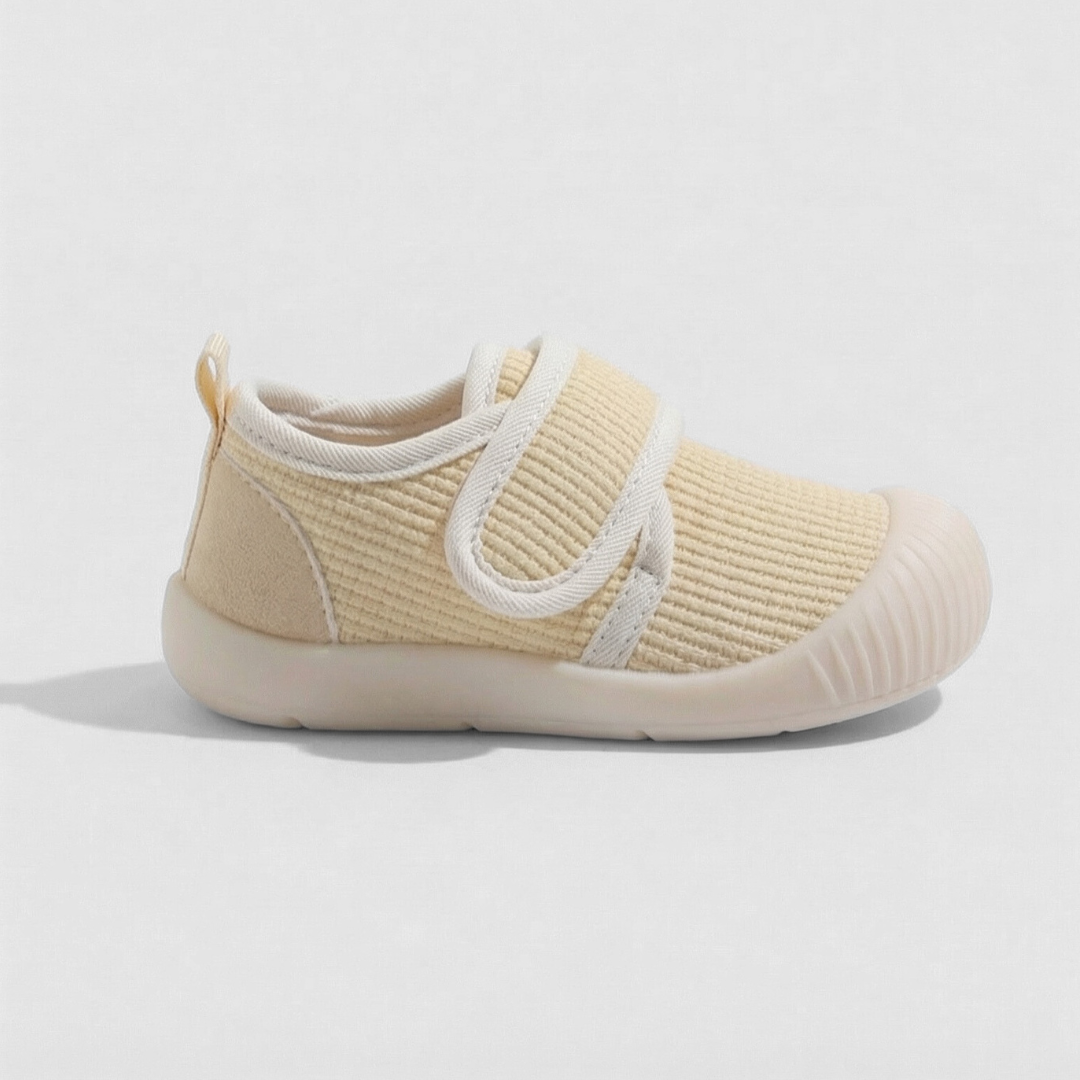
That's exactly the thinking behind our Baby Waves first walkers: lightweight, flexible and roomy, with grippy soles. Not sure what size to pick? Our size guide shows you how to measure at home in a minute.
Is my baby a late walker?
Probably not! There's a wide range of normal. Some babies walk before their first birthday, and others take their time well into their second year. Babies who are great crawlers or bottom-scooters are sometimes in less of a hurry to walk, simply because they already get around just fine. The National Library of Medicine's MedlinePlus guide to toddler development says many children walk well by 12 to 15 months, and suggests talking with your child's provider if they aren't walking by 18 months.
That said, trust your instincts. It's a good idea to talk with your pediatrician if your child:
- Isn't walking on their own by about 18 months
- Isn't pulling up to stand or cruising by around 12 to 15 months
- Seems to use one side of their body much more than the other
- Loses skills they once had
For more detail, see our guide on when to worry if your toddler is not walking yet.
Your pediatrician can check in on your child's development at well-child visits, and they're always the best person to ask if something feels off. Between visits, the free CDC Milestone Tracker app makes it easy to keep track, and if you have concerns you can also reach out to your state's early intervention program.
Frequently asked questions
Is it normal for a baby to walk at 9 or 10 months?
Yes. Some babies take their first steps before their first birthday. Early walking is simply one end of the normal range. It doesn't predict how quickly they'll reach other milestones.
Should I hold my baby's hands to help them walk?
Holding hands for short, playful practice is fine, and many babies love it. Just be sure to also give them plenty of time to pull up, cruise and balance on their own, since that's how they build the strength and confidence to walk independently.
Why does my toddler still crawl sometimes?
That's completely normal. Even after they start walking, many toddlers switch back to crawling when they want to move quickly. They use whatever gets them there fastest!
How long does it take to go from first steps to walking well?
It varies, but many children progress from shaky first steps to more confident walking within weeks. At first they'll walk with their feet wide apart and may fall when trying to stop; over time, they'll learn to stop, turn and squat with ease.
This article is for general informational purposes only and isn't a substitute for professional medical advice. Every child develops at their own pace. If you have questions or concerns about your child's development, please talk with your pediatrician.
Sources
- Centers for Disease Control and Prevention (CDC), Milestones by 1 Year, 15 Months, 18 Months and 2 Years
- American Academy of Pediatrics, HealthyChildren.org, Movement Milestones in Babies 8 to 12 Months Old and Baby Walkers: A Dangerous Choice
- MedlinePlus (U.S. National Library of Medicine), Toddler Development
- CDC, Milestone Tracker App and Early Intervention
- U.S. Consumer Product Safety Commission, Anchor It!





Share and get 15% off!
Simply share this product on one of the following social networks and you will unlock 15% off!